



Skip to content

Insurance AI Glossary

A

Accuracy A measure of how often an AI system produces correct results. While accuracy is important, insurers must also consider context, explainability, and risk when evaluating AI performance. 

Related Resource

2025.08.12-newsletter-blog-what-is-model-drift-and-how-does-it-affect-insurance-ai

BLOG

What Is Model Drift and How Does It Affect Insurance AI
Understand model drift, its risks to insurance AI, and how to detect and manage it.

Read Now
Agentic AI An AI approach where systems are designed to autonomously plan, make decisions, and take actions toward defined goals. Agentic AI can coordinate multiple steps or tools – or entire processes – making it useful for complex workflows requiring adaptability.

Related Resource

2025.05.30-library-what-is-agentic-ai

EBOOK

What Is Agentic AI?
Understand what sets agentic AI apart in insurance.

Download Now
AI Agent A software entity that uses artificial intelligence to perceive information, make decisions, and take action within a system or environment. In insurance, AI agents can perform tasks such as extracting insights from loss run histories, handling FNOL/FROI setup, accessing and extracting premium audit data, requesting missing information, and executing other workflows – often with a high degree of autonomy. 

Related Resource

2025.04.22-newsletter-blog-14-common-ai-use-cases

BLOG

14 Common AI Use Cases for Insurance Underwriting and Claims
Explore high-ROI AI use cases for insurers.

Read Now
AI Governance The framework of policies, processes, and controls that guide how an organization develops, deploys, and monitors AI systems. AI governance addresses risk management, compliance, ethical considerations, data privacy, and accountability. In an insurance context, AI governance ensures that your AI tools operate reliably and transparently, protecting your customers’ interests while aligning with business objectives and regulatory requirements. Strong governance fosters stakeholder trust and facilitates the adoption of responsible AI at scale.

Related Resources

2025.05.02-library-guide-ai-governance-committees

guide

AI Governance Committees: Building a Foundation for Trust
Establish a governance committee aligned to regulation and best practice.

Download Now
Glossary-AI-Principles

ROOTS

8 Core Principles for Responsible and Ethical AI
This framework encourages explicit explanations for AI decisions, protects user data, and emphasizes dependable models with continual improvement and human-AI collaboration.

Read Now
Algorithm A defined set of rules or instructions that a computer follows to complete a task or solve a problem. In AI systems, algorithms govern how data is processed, learned from, and acted upon. Different algorithms are suited to various insurance use cases, such as classification or prediction.
API (Application Programming Interface) A set of rules that allows different software systems to communicate with one another. APIs enable insurers to integrate AI capabilities into existing platforms without rebuilding core systems. 
Artificial Intelligence (AI) This is the broad field of computer science focused on building systems that perform tasks typically requiring human intelligence, (e.g., learning from data, pattern recognition, understanding language, problem-solving, etc.) In insurance, AI is used to automate processes, assess risk, aid in fraud detection, and enhance customer interactions at scale.
Automation The use of technology to perform tasks with minimal human intervention. In insurance, automation reduces manual effort in areas like claims intake, document handling, and policy servicing. AI-driven automation surpasses traditional automation in its ability to handle more complex, judgment-based tasks.

B

Bias (in AI) Systematic errors in AI outputs caused by skewed data, flawed assumptions, or design choices. In insurance, bias can impact fairness, compliance, and trust, making mitigation strategies essential.

Related Resource

2025.12.16-newsletter-blog-how-ai-transparency-can-prevent-bias-pricing-approvals

BLOG

How AI Transparency Can Prevent Bias in Insurance Pricing or Approvals
Learn how AI transparency prevents bias in pricing and approvals.

Read Now

C

Change Management Change management is the structured approach used to prepare, support, and enable insurance teams as artificial intelligence is introduced into operational workflows. It ensures that employees understand how AI affects their roles, how to interact with AI outputs, and when human judgment or escalation is required. 

Related Resource

2025.06.27-newsletter-guide-change-management-how-to-navigate-change-ai-powered-insurance-future

GUIDE

How to Navigate Change in the AI-Powered Insurance Future
Understand communication, engagement, and leadership strategies for an AI-powered future.

Download Now
Cloud-Based Refers to software or infrastructure delivered over the internet rather than hosted on local servers. Cloud-based AI solutions allow insurers to scale processing power, deploy updates quickly, and integrate advanced AI capabilities without heavy infrastructure investments.
Computer Vision An AI discipline that enables machines to interpret and analyze visual information such as images and videos. In insurance, computer vision can aid in damage assessment, site and property inspections, and fraud detection. 
Confidence Score A confidence score is a numerical or categorical indicator generated by an AI system that reflects the system’s assessed likelihood that an output is accurate, complete, and reliable. It represents the AI’s level of certainty based on available data, model behavior, and predefined evaluation criteria.

Related Resource

Glossary-Benchmarks

DATA

Roots Insurance AI Benchmark Results
For common insurance activities like document classification and data extraction Roots delivers more accurate outputs than LLMs.

Read Now

D

Data Information used by AI systems to learn, analyze, and make decisions. Data can take many forms, including text, numbers, images, device output readings, and other inputs. High-quality data is foundational to effective AI outcomes in insurance. 

Related Resource

2025.06.18-newsletter-blog-why-you-dont-need-perfect-data-launch-ai 

BLOG

Why You Don’t Need Perfect Data to Launch AI
AI success doesn’t require a massive data-cleaning project – just the right partner.

Read Now
Deep Learning A subset of machine learning that uses multi-layered neural networks to model complex patterns in large datasets. Deep learning is particularly effective for image recognition, speech processing, and language understanding – all key capabilities for modern insurance AI applications. 
Deployment The process of moving an AI model from development into a live production environment where it can be used in real-world operations. Successful deployment includes monitoring, governance, and ongoing performance management. 
Drift Refers to the gradual degradation of an AI system’s performance over time due to changes in data, workflows, external conditions, or business rules that differ from those present during initial training or validation. As these conditions evolve, the AI’s outputs may become less accurate, consistent, or reliable if not actively monitored and adjusted. 

Related Resource

2025.08.12-newsletter-blog-what-is-model-drift-and-how-does-it-affect-insurance-ai

BLOG

What Is Model Drift and How Does It Affect Insurance AI?
Learn what model drift is and why it threatens insurance AI.

Read Now

E

Exception Handling Exception handling is the structured process for identifying, routing, reviewing, and resolving cases where an AI system cannot confidently complete a task or where outputs fall outside predefined rules, thresholds, or expected behavior. It ensures that exceptions are managed consistently, transparently, and with appropriate human oversight.

Related Resource

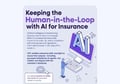
2025.05.16-resources-infographic-keeping-human-in-the-loop-ai-insurance

INFOGRAPHIC

Keeping the Human-in-the-Loop with AI for Insurance
This infographic breaks down how HITL strengthens agentic AI.

Download Now
Explainability The degree to which an AI system’s decisions can be understood by humans. Explainability is critical in insurance for regulatory compliance, stakeholder trust, and effective oversight. 

Related Resource

2025.09.04-library-webinar-on-demand-making-ai-decisions-transparent-regulators-insurance-teams

ON-DEMAND WEBINAR

Explainability Matters: Making AI Decisions Transparent for Regulators and Insurance Teams
This session breaks down the concept of having clear insight into how AI models make decisions.

Watch Now

F

Fine-Tuning The process of adapting a pre-trained AI model using a smaller, domain-specific dataset. Fine-tuning helps tailor general AI models to insurance-specific language, documents, or tasks, improving relevance and performance. 

Related Resources

2025.08.05-library-webinar-on-demand-fine-tuned-ai-for-insurance-why-precision-matters

ON-DEMAND WEBINAR

Fine-Tuned AI for Insurance: Why Precision Matters
Learn why fine-tuning is essential and what it takes to do it successfully.
Watch Now
2025.05.28-newsletter-blog-what-is-fine-tuning-in-large-language-models

BLOG

What Is Fine-Tuning in Large Language Models—and Why Does It Matter for Insurance AI?
Learn more about fine-tuning and how it enables agentic AI.

Read Now

G

Generative AI A class of AI systems designed to create (“generate”) new content – such as text, images, or code – rather than simply analyzing existing data. Generative AI trained on insurance data can perform myriad tasks – draft emails, summarize claims files, create certificates of insurance (COI) on demand, etc. Its value lies in accelerating insurance knowledge work while prioritizing human oversight. 
Governance Is the framework of policies, roles, controls, and oversight processes that guide how artificial intelligence is selected, deployed, monitored, and managed within an insurance organization. It establishes accountability, decision rights, and standards to ensure AI systems operate responsibly, securely, and in alignment with business objectives, regulatory requirements, and ethical expectations.

Related Resources

2025.05.02-library-guide-ai-governance-committees

guide

AI Governance Committees: Building a Foundation for Trust
Establish a governance committee aligned to regulation and best practice.

Download Now
Glossary-AI-Principles

ROOTS

8 Core Principles for Responsible and Ethical AI
This framework encourages explicit explanations for AI decisions, protects user data, and emphasizes dependable models with continual improvement and human-AI collaboration.

Read Now

H

Hallucination When an AI model generates information that appears plausible but is incorrect, unsupported, or fabricated. Hallucinations are a known risk in generative AI, making governance, validation, and human oversight especially critical for a highly regulated industry like insurance. 
Human-in-the-Loop (HITL) An AI deployment approach where human experts review, validate, or override AI outputs. HITL is essential in insurance AI to ensure accuracy, fairness, and regulatory compliance while still benefiting from automation. 

Related Resource

2025.05.16-newsletter-infographic-keeping-human-in-the-loop-ai-insurance

INFOGRAPHIC

Keeping the Human-in-the-Loop with AI for Insurance
Learn how HITL strengthens agentic AI.

Download Now

I

Inference The process where a trained AI model applies its learned patterns to new, unseen data to generate predictions, classifications, or responses. Inference happens after training is complete – it's the "production" phase where the model does actual work. In insurance contexts, inference occurs when a model reviews a claim, assesses risk, or provides an answer in real-time. 
Integration The process of connecting AI systems with existing insurance platforms, workflows, and data sources. Effective integration ensures AI enhances operations without disrupting established processes. 
Intelligent Automation The combination of automation technologies with AI capabilities, such as machine learning, natural-language processing (NLP), or computer vision. Intelligent automation enables systems to handle variability and unstructured data, making it well-suited for insurance processes that require interpretation and support for decision-making.
Intelligent Document Processing (IDP) A technology that uses AI to extract, classify, and validate information from documents. IDP goes beyond basic optical character recognition (OCR) by understanding context and meaning. In insurance, IDP is commonly used for claims forms, loss runs, medical records, and policy documents. 

J

Junction-Tree Algorithm Is a machine learning method used in probabilistic graphical models to compute marginal probabilities. AI is probabilistic, meaning that it calculates probability to reach the best answer as opposed to software systems, which are deterministic, meaning they operate to create a determined outcome. 

K

Kernel Method In machine learning, these are a class of algorithms for pattern analysis – the search for and study of relations (e.g. rankings, principal components, correlations, classifications) in datasets.

L

Large Language Model (LLM) A type of AI model trained on vast amounts of text to understand and generate human-like language. LLMs can summarize documents, answer questions, extract information, and generate written content. In insurance applications, domain-specific LLMs (e.g., ones trained on insurance data) are optimized to analyze policy documents, claims notes, correspondence, and regulatory text. 
Model Risk Management A framework for identifying, assessing, monitoring, and mitigating risks associated with AI and analytical models. In insurance, model risk management helps ensure AI systems are reliable, compliant, and aligned with business objectives. 

M

Machine Learning (ML) A subset of AI that enables systems to learn from data and improve performance over time without being explicitly programmed. Machine learning models identify patterns within historical data and apply those patterns to future scenarios. Insurers use ML for underwriting, pricing, claims triage, and fraud detection. 
Model A mathematical representation created by training an AI or machine learning system on data. The model captures patterns and relationships that allow it to make predictions or decisions when presented with new information. In insurance, models might estimate loss severity, classify claims, or flag anomalies. 

N

Natural Language Processing (NLP) A field of AI focused on enabling computers to understand, interpret, and generate/“communicate” through human language. NLP powers applications like document classification, sentiment analysis, summarization, and question answering in insurance operations. 
Neural Network A computational model inspired by the human brain, consisting of interconnected layers of nodes that process information. Neural networks are foundational to many AI techniques, including deep learning. 

O

Optical Character Recognition (OCR) A technology that converts scanned images or text and other elements within PDFs into machine-readable data. OCR is often a foundational step in document processing, enabling AI systems to analyze previously inaccessible information. 

Related Resource

2025.07.15-newsletter-blog-why-ocr-alone-isnt-enough-for-insurance-document-processing

BLOG

Why OCR Alone Isn’t Enough for Insurance Document Processing
Learn how pairing OCR with insurance-trained LLMs transforms document processing.

Read Now
Orchestration Orchestration is the coordination and management of multiple AI components, business rules, systems, and human workflows to execute an insurance process end-to-end. It determines the sequence of actions, decision points, handoffs, and integrations required to complete work accurately, efficiently, and within governance controls.  Effective orchestration enables insurers to scale AI safely.

P

Pilot A pilot is a limited, controlled production deployment of a technology or AI solution designed to validate operational readiness, user adoption, and governance effectiveness within live insurance workflows. The purpose of a pilot is to confirm that a solution proven through a proof of value can perform reliably at scale-like conditions while operating within established controls, policies, and performance standards. A pilot provides final validation before enterprise rollout. 
Predictive Analytics The use of data, statistical methods, and machine learning to forecast future outcomes. In insurance, predictive analytics supports risk assessment, pricing, claims severity estimation, customer behavior modeling, and other functions. 
Prompt An instruction or input provided to an AI model – particularly for generative AI – to guide its response. Prompts can include questions, commands, context, or examples. Well-designed prompts based on specific domain knowledge (e.g., in insurance) help to ensure the most accurate and relevant outputs. 
Prompt Engineering The practice of crafting instructions (prompts) to guide AI models toward desired outputs. Prompt engineering involves strategic word choice, domain context framing (i.e., insurance expertise), the use of relevant examples, and formatting to enhance response relevance, quality, and accuracy. Effective prompt engineering requires both creativity and technical understanding. It helps users derive maximum value from AI tools while minimizing potential errors or misinterpretations. 
Proof of Concept A proof of concept (PoC) is a controlled, time-bound evaluation designed to validate whether a proposed technology or AI solution can perform a defined function within an insurance context. The purpose of a PoC is to confirm technical feasibility, workflow fit, data compatibility, and baseline performance before committing to broader implementation. A PoC is not intended to deliver full business value or production-level outcomes.
Proof of Value A proof of value (PoV) is a structured, outcome-focused evaluation designed to demonstrate measurable business impact from a technology or AI solution within real insurance workflows. Unlike a proof of concept, a PoV validates not only that the solution works, but that it delivers quantifiable value aligned to operational, financial, and service objectives. A PoV provides decision-ready evidence to support scale-up or production approval.

Q

Quality Metric A measurement that evaluates specific aspects of model performance. Like a report card that grades different aspects of a system’s capabilities. Examples include drift, accuracy, latency, etc. 

R

Reinforcement Learning A machine learning technique where an AI system learns by interacting with an environment and receiving feedback based on its actions. While less common in core insurance operations, it is useful for optimization and decision-making scenarios. 
Retrieval-Augmented Generation (RAG) An AI approach that combines generative models with external data sources. Instead of relying solely on what the model learned during training, RAG retrieves relevant information in real time to ground responses. This is especially valuable for insurance use cases requiring accuracy and traceability. 

S

Shadow AI This is an umbrella term that refers to the unsanctioned use (wittingly or not) of AI tools, models, and applications bypassing an organization’s official IT policies and security protocols. Use of shadow AI can create significant risks for insurers and other businesses, including sensitive data leakage, regulatory compliance failures, and intellectual property exposure. 
Structured Data Data that is organized into predefined formats, such as tables or databases, with clearly defined fields. Examples include policy records, claim amounts, and dates. Structured data is often easier for traditional analytics and AI models to process.
Structured Data2 Data that is organized into predefined formats, such as tables or databases, with clearly defined fields. Examples include policy records, claim amounts, and dates. Structured data is often easier for traditional analytics and AI models to process.

Related Resource

ebook-solving

WHITEPAPER

Solving the Insurance Industry’s Unstructured Data Challenge with AI
Learn how AI can extract 90% more data from submissions with 95% accuracy leading to insurers reducing underwriting time by up to 70%.

Download Now
Supervised Learning A machine learning approach where models are trained on labeled data, meaning the correct outcomes are known in advance. This method is widely applied in insurance for classification and prediction tasks. 

T

Telematics The use of connected devices and sensors to collect real-time data, often related to vehicle usage or behavior. In insurance, telematics data supports usage-based insurance product development, risk assessment, and proactive loss prevention. 
Token A unit of text – such as a word, part of a word, or symbol – that an AI language model processes. Tokens are the basic building blocks used by LLMs to understand and generate language.
Training The process of teaching an insurance AI model by exposing it to historical data so it can learn patterns and relationships. During training, the model adjusts its internal parameters to improve accuracy. Effective training on large bodies of insurance data is critical for ensuring AI systems perform reliably in insurance workflows. 
Training Data The dataset used to train an AI or machine learning model. Training data must be representative, accurate, and relevant to the problem being solved. In insurance, training data often includes past claims, policy information, underwriting decisions, or customer interactions. As a rule, the more insurance data used in training insurance AI, the better the outcomes. 

U

Unstructured Data Data that does not follow a predefined format, such as emails, adjusters’ notes, PDFs, images, and audio recordings. Much of insurance data is unstructured, making NLP, computer vision, and insurance domain-trained LLMs – essential for extracting maximum value from it. 

Related Resource

Header Image October Email Unstructured Data Whitepaper

WHITEPAPER

Solving the Insurance Industry’s Unstructured Data Challenge with AI
Discover practical strategies of using AI to unlock value in unstructured data.

Download Now
Unsupervised Learning A learning approach where models identify patterns in unlabeled data without predefined outcomes. In insurance, unsupervised learning is often used for clustering, anomaly detection, and exploratory analysis. 
Use Cases The framework of policies, processes, and controls that guide how an organization develops, deploys, and monitors AI systems. AI governance addresses risk management, compliance, ethical considerations, data privacy, and accountability. In an insurance context, AI governance ensures that your AI tools operate reliably and transparently, protecting your customers’ interests and aligning with business objectives and regulatory requirements. Strong governance fosters stakeholder trust and facilitates the adoption of responsible AI at scale. 

Related Resource

2025.05.13-newsletter-blog-kickstart-your-agentic-ai-journey

BLOG

Kickstart Your Agentic AI Journey with a Single Use Case
Learn how to choose the right agentic AI use case in insurance.

Read Now
User Adoption User adoption is the extent to which insurance employees consistently and effectively use an AI solution as intended within their daily workflows. It reflects whether users trust the system, understand its role, and integrate AI outputs into decision-making and operational processes.

Related Resource

Whitepaper-image

REPORT

State of AI Adoption in Insurance 2025
Discover the latest insights into AI adoption in the insurance.


Download Now

V

Variability (data) Variability refers to the dispersion of a set of data. It provides users with a means to describe how much data sets vary and allows insurance experts to use statistics to compare their data with other sets of data to quantify factors such as risk and predictability.

W

Workflow A defined sequence of steps or tasks designed to complete a business process, e.g., claims processing, submission processing, etc. AI-enabled workflows adapt dynamically based on inputs, enabling more efficient and intelligent insurance operations. 

Related Resources

2025.11.06-newsletter-on-demand-webinar-workflow-clarity-drive-ai-success

ON-DEMAND WEBINAR

Workflow Clarity to Drive AI Success
Learn how workflow insight helps insurers identify AI opportunities.

Watch Now
2025.08.19-newsletter-blog-sharpen-your-insurance-workflow-with-ai

BLOG

Sharpen Your Insurance Workflow with AI
Learn how AI streamlines workflows, boosts team focus, and reduces workplace chaos.

Read Now

X

Explainable AI Models (XAI) An emerging field encompassing methods and techniques to address the “black box” problem by rendering transparent the decisions and actions of complex AI and machine learning models for which even developers struggle to explain how it arrived at a specific result. XAI models are anticipated to play a crucial role in fostering trust, accountability, and transparency in insurance AI systems.

Y

York-Antwerp Rules (YAR) A set of internationally recognized guidelines that govern the principle of “general average” in maritime law, a concept where all parties involved in a sea voyage proportionally calculate and share losses and expenses incurred when part of the cargo or ship is sacrificed to save the venture from a common peril. 

Z

Zero-Shot Learning Is a machine learning method where an AI model classifies or understands concepts unencountered during training, using auxiliary information (e.g., text descriptions or attributes) to generalize knowledge, giving it the flexibility to handle new tasks or categories without retraining.

Have a suggestion?

Let us know which AI term you’d like to see added.