



Across every functional layer of insurance – underwriting, claims, servicing, and beyond – AI-driven workflows are fast becoming central to how insurance work gets done. But as these systems take on greater responsibility, anyone deploying or overseeing them faces a critical question: how does the AI know when it doesn't know enough to act?
The answer lies in confidence scoring and user-set thresholds – mechanisms that determine when an AI agent should proceed autonomously and when it should stop and ask a human for help. For insurance professionals tasked with making AI purchase or deployment decisions, understanding how these systems work and how they can be configured is no longer optional knowledge.

What Confidence Scoring Actually Measures
Confidence scoring is a method for estimating the probability that an AI model's output is correct. It is not a simple self-assessment the AI itself conducts, since a model cannot, or should not, reliably answer whether it is confident in a given output. Or as the old saying goes, “trust, but verify.”
Instead, robust confidence scoring relies on a few repeatable technical methods:
-
Logged probabilities, or logprobs, to measure how heavily a model weights a particular output, essentially the statistical certainty behind each word or data point the model produces.
-
Verbalized confidence prompts the model to express its uncertainty in natural language, which can then be quantified and acted upon.
-
Consistency sampling runs the same query multiple times and measures variance across responses – high variability signals low reliability.
These elements matter in insurance AI because the data being processed often includes unstructured documents, handwritten forms, multi-page submissions, complex policy language, and conflicting data from multiple sources. Confidence scoring allows the system to flag outputs where uncertainty is high, rather than proceeding as if all outputs are equally reliable.
The risk of not having robust confidence-scoring capabilities is AI overconfidence, which is when a model appears “certain” about data it might have misread, misclassified, or extrapolated incorrectly. In claims or underwriting contexts, that kind of “silent error” can be costly.

How Confidence Scores and User-Set Thresholds Drive Better Insurance Outcomes
Confidence scores become operationally useful only when paired with thresholds that define when to trigger human review.
The most effective approach to this is having user-configurable thresholds that align with the risk profile of specific workflows. For example, a carrier processing high-volume, low-complexity endorsement requests might set a relatively permissive threshold – enabling AI to handle most cases without interruption. The same carrier handling large commercial property claims would set a more conservative threshold for where uncertainty triggers an exception for human review.
Getting this configuration right requires real insurance expertise. “Thresholding” is a risk-management decision, not a technical one. Professionals who understand the causes and effects of claims leakage, adverse selection, compliance exposure, and other insurance-related concepts are best positioned to determine the acceptable level of AI confidence in a given context.

Common Scenarios That Trigger Exceptions
Exceptions occur when an AI model fails to meet a defined confidence threshold or encounters a situation outside its training data. These are not system failures. They are evidence that a system is working as designed. Common exception scenarios in insurance workflows include:
- Severely degraded or illegible inputs: Even the most capable AI has limits when source documents are too damaged, poorly scanned, or incomplete to extract reliable data. In those cases, a low confidence score surfaces the problem for human review rather than allowing a bad read to move forward unchecked.
- Missing or conflicting information: When data extraction pulls two different numbers for the same figure, a missing date of loss, or contradictory policy details, a well-configured system should escalate to a human expert, rather than “resolve” the conflict by defaulting to one value.
- High-value or high-risk decisions: Straight-through processing makes strong operational sense for routine, low-dollar-amount claims. High-value claims, large commercial accounts, or situations with material financial exposure call for conservative thresholds to build human judgment, and oversight, into workflows by design.
- Edge cases and anomalies: Complex liability disputes, unusual underwriting risks, multi-party losses, or any scenario that deviates meaningfully from standard patterns are precisely the situations where AI training data is thinnest and human expertise is most valuable.
- Ethical or legal ambiguity: When AI outputs could reflect bias or raise a regulatory concern, human review isn't just a good idea. Human review in these scenarios provides audit trails and other accountability measures increasingly required by regulators.
These scenarios represent predictable categories of uncertainty, not random system failures. A well-configured AI anticipates them, flags them consistently, and routes them to the right reviewer without friction. The goal isn't to minimize exceptions at all costs. It's to make sure the right decisions reach the right resource at the right time.

Human Review Makes AI Smarter Over Time
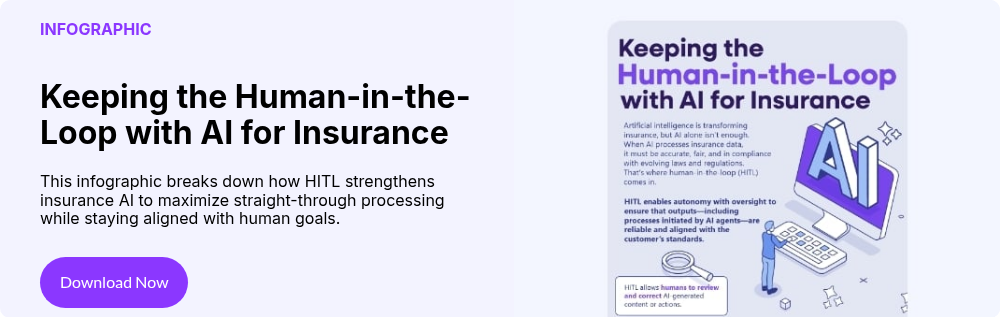
The quality of the human-in-the-loop (HITL) architecture determines whether confidence scoring and exception handling improve outcomes or simply add friction. HITL also permits oversight in the workflow based on other factors (e.g., business rules and logic).
A well-designed HITL system does more than route exceptions to a queue. It presents the exception in context, surfaces the relevant data needing confirmation, and captures the human reviewer's decision in a way that feeds back into the model's learning. Over time, the model gets more accurate, which means fewer exceptions without any drop in oversight. Applied with purpose, HITL effectively enables continuous model fine-tuning, especially in models built for insurance.
These qualities distinguish HITL used merely as a safety net from deploying an insurance domain-specific HITL as a true performance driver. Insurance businesses evaluating AI platforms should scrutinize not just whether a system supports human review, but how that review is structured, what data is surfaced to the reviewer, and whether reviewer decisions are systematically captured and used to continuously improve model performance.

As AI becomes more deeply embedded in insurance operations, the organizations that get this right will see measurable gains in accuracy, throughput, and risk management. Those who treat HITL as a checkbox rather than a core design principle will likely find themselves managing the consequences of the overconfident AI.
Confidence scoring and user-set thresholds are not advanced features. They are baseline expectations for any AI deployment in a high-stakes, regulated industry. Knowing how to evaluate them is simply part of knowing how to evaluate AI.