


Insurance leaders are under pressure to move faster with AI while controlling cost, risk, and complexity. Leadership expects technology delivered quickly, and not just prototypes, but solutions that work reliably in real production environments. Speed and accuracy are quickly becoming competitive advantages. Policyholders and agents expect immediate responses and consistent outcomes. When processes slow down or results are inconsistent, business is lost.
That pressure is driving a common question: should we build or buy insurance AI?
If my team can write prompts and use AI coding tools, why not build our own?
The Gap Between Demo and Production
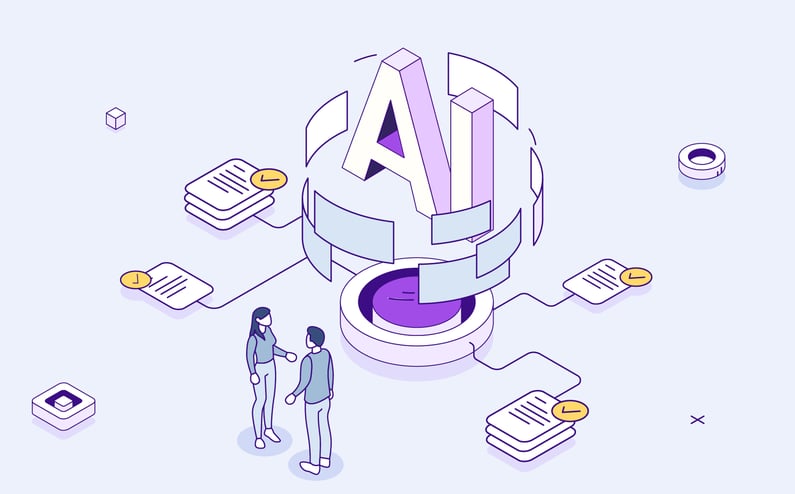
It’s a reasonable question, and most teams ask it after seeing what AI can do in a proof of concept. A quick demo looks smart. A pilot looks inexpensive. But production-ready AI in insurance is not a prompt layered on top of a model. It includes document handling, OCR, workflow logic, business logic, enterprise system integrations, security, monitoring, audit trails, confidence scoring, human review, compliance, and continuous updates. The gap between a convincing demo and a dependable and well-governed production system is where most internal AI builds run into trouble.
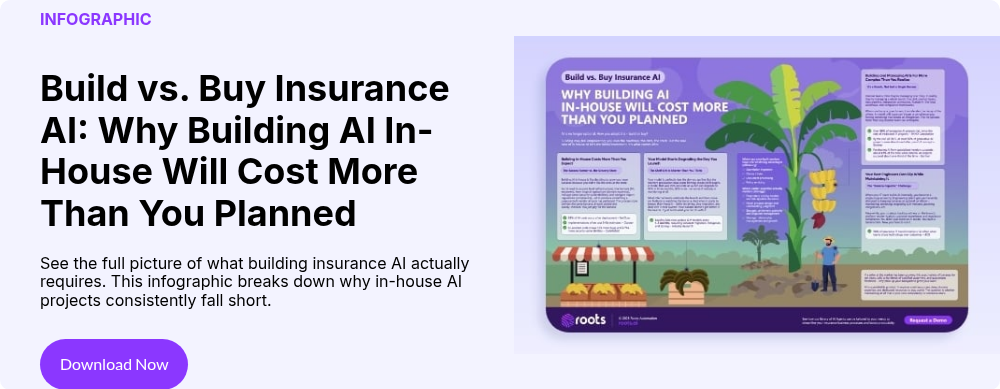
That is why the better question is not whether you can build it. It’s whether you should. For most insurance workflows, the answer is no. A large share of AI initiatives never deliver expected outcomes. Many never reach production, and teams abandon a significant portion after proof of concept. What starts as a project becomes a permanent operational responsibility.
6 Reasons Vibe-Coding Your Insurance AI Won’t Work
There is a growing temptation to treat AI the way developers treat rapid prototyping: move fast, iterate, ship something. That instinct works in some contexts. In regulated, high-volume insurance workflows, it creates serious risk. Here’s why.
1. Prompting is the easy part.
It often begins with a simple assumption: “all you are doing is prompting. We can do that ourselves.” But prompting is the easy part. The hard part is everything around it.
A prompt can guide behavior, but it does not enforce it. It doesn’t prevent drift. It doesn’t ensure accuracy in edge cases. It doesn’t create audit trails, explainability, or compliance with insurance regulations. It doesn’t connect cleanly to policy systems, claims data, or underwriting rules.
Domain-specific insurance AI solutions are trained on hundreds of thousands, often millions, of real insurance documents across submissions, loss runs, claims files, endorsements, audits, and policy servicing transactions. That depth of exposure matters. It allows AI to recognize patterns, handle variation, and perform consistently across formats, carriers, and edge cases. An internal build starts from zero.
2. You don’t control your dependencies.
When teams vibe-code AI systems, they’re not just writing prompts. They’re building on a stack of dependencies they don’t fully understand or control: third-party APIs, open-source libraries, model providers, orchestration tools, and more. Each dependency is a potential liability.
Any one of those components can change, break, or be deprecated without warning. A library update shifts behavior. An API changes its schema. A model provider retires an endpoint. Your system, which worked perfectly last Tuesday, now fails in production. And the team that built it with momentum and intuition is now debugging something they never fully mapped.
In insurance, that kind of fragility isn’t a technical inconvenience. It’s a compliance and operational risk.
3. Speed does not guarantee reliability.
There’s a growing misconception that faster development means better outcomes. AI coding tools can accelerate early builds, but speed does not equal reliability. AI-generated code introduces more defects and security risks than human-written code. What works in a prototype can fail under real-world scale and conditions.
In insurance, that risk isn’t acceptable. A single incorrect output in claims, coverage, or servicing creates financial loss, compliance exposure, or customer harm. Insurers can’t afford to get it wrong.
4. Model churn is accelerating faster than most teams can manage.
The AI industry isn’t slowing down. It’s speeding up. Model release cycles that used to span years now span weeks. Here’s what the data shows on model lifespans across major AI providers:
| Transition | Release Gap |
| GPT-3 → GPT-3.5 | 29 months |
| GPT-4 → GPT-4o | 14 months |
| GPT-5 → GPT-5.1 | 3 months |
| Opus 4.6 → Opus 4.7 | 2 months |
| Opus 4.6 → Sonnet 4.7 | 12 days |
In December 2025, three flagship models from three different labs shipped within twelve days of each other. The industry now tracks over 262 model releases across major providers.
Every model transition requires real work: evaluation, prompt re-engineering, testing, compliance checks, and integration updates. This is not optional. An AI system running on a deprecated model degrades or breaks.
In 2023, an internal team might face two or three model transitions per year. Nowadays, they face six to twelve or more across providers. Your team is not just building a system. They are committing to a permanent, accelerating AI model evaluation and maintenance cycle.
5. The true cost is almost never counted correctly.
Internal AI proposals tend to account for visible costs: developer salaries, a cloud pilot, some initial tooling. What they almost never include is the full picture.
| Cost Category | What IT Counts | What They Miss |
| Initial Build | Dev salaries, cloud pilot | Architecture, user interface, security review, data pipelines |
| UI (user interface) | Costs – UX design and iteration management | Human-centered front-end experience, human-in-the-loop exception handling and review, multimodal outputs |
| Talent | Current team hours | ML/AI hires ($200K-$500K), retention |
| Maintenance | (Often zero) | Model retraining, drift detection, human review ops |
| Compliance | (Often zero) | Audit trails, bias testing ($10K-$100K/yr) |
| LLM Churn | (Never counted) | 6-12+ transitions/yr: evaluation, testing, migration |
| Opportunity Cost | (Never counted) | Strategic backlog permanently delayed |
Sixty-five percent of total AI costs materialize after deployment, and 85% of organizations misestimate AI project costs by more than 10%. Enterprise insurance AI implementations typically cost three to five times the initial estimate when accounting for integration, infrastructure, and operational overhead.
6. AI is not a project. It's an ongoing business.
AI doesn’t behave like traditional software. You cannot build it once and move on. Models change. Data shifts. Someone must monitor performance. Someone must validate output. New risks emerge over time.
Building insurance AI internally means taking on infrastructure, specialized talent, model training, ongoing care, quality control, and constant oversight. You’re responsible for producing consistent results over time, in a domain that is not your core business, using capabilities that specialized providers already deliver at scale. The question isn’t whether you can carry that weight. It’s whether you should.
Focus on What Only You Can Do
There are cases where building makes sense. If the use case is truly unique and tied directly to your competitive differentiation, internal development may be appropriate. But most insurance workflow automation challenges are not unique. Submission intake is not unique. Claims indexing is not unique. Endorsement processing is not unique. Document classification, extraction, and routing are not unique. These are shared challenges across the industry, and specialized providers already solve them at scale.
Insurance carriers should focus on what they do best. Risk selection, pricing, coverage decisions, and claims judgment are core competencies. Those should remain with experienced professionals. The work that leads to those decisions is different: reading inbound emails, separating documents, extracting data, validating information, routing work, preparing files for review. These are complex, high-volume tasks, but they are not where carriers differentiate. This is where specialized insurance AI solutions create value.
For IT leaders, choosing a vendor is not a loss of control. It’s a strategic decision about where to invest time and talent. Insurance IT teams already face significant transformation pressure. Adding custom internal AI builds for common workflow challenges delays more important initiatives and stretches resources further. The most effective insurers focus internal efforts where it matters most and partner where expertise, speed, and reliability are critical.
Insurance AI is not about prompts or prototypes. It’s about trust, usability, performance, and compliant results in production.
The insurers that win will not be the ones that tried to build everything themselves. They will be the ones that made the right build vs. buy decision, chose the right partners, moved faster, reduced risk, and allowed their teams to focus on what truly drives the business forward.
That is the difference between experimenting with AI and actually using it to grow.