




It's Monday morning. Your underwriting team is staring down 200 submissions that came in over the weekend. Your claims unit just got hit with a new CAT event. And somewhere in a conference room, a steering committee is still debating which AI vendor to shortlist. Meanwhile, 93% of the industry has already moved past that conversation. The gap isn't coming. It's here.
Based on Roots' newly released State of AI Adoption in Insurance 2026 report, the question is no longer whether AI is relevant. It's where to deploy it next, how fast to scale, and how to build the governance structures that make responsible deployment possible. This is a market that has largely made up its mind about AI's value. The debate has shifted from "should we?" to "how do we do this well?"

7 Stats That Define Where Insurance AI Stands in 2026
The Insurance AI Use Cases Gaining Momentum in 2026
Adoption is concentrated in high-volume, document-heavy workflows where the value is clear, the use case is well-defined, and the implementation risk is relatively low. Workflow and process automation leads at 53%, followed by unstructured document processing (46%) and AI copilots for employees (45%). These aren't flashy applications. They are practical ones, focused on throughput, consistency, and giving skilled employees more time to do the work that actually requires their judgment.
More complex or customer-facing applications like dynamic pricing, compliance monitoring, and personalized product recommendations are still at the margins. Not because insurers don't see their potential, but because they require stronger data foundations, tighter regulatory alignment, and a level of model accuracy that most organizations are still working toward.
By function, the priorities look a bit different. Underwriting teams are focused on submission intake automation, risk scoring and segmentation, and AI-generated summaries of submission documents, all aimed at reducing friction in the front end of the workflow and letting underwriters spend more time on actual risk evaluation.
Claims organizations are prioritizing document processing and data extraction, claims file summarization, and predictive analytics that can surface severity or escalation risk earlier in the process.
Policy servicing is seeing AI move noticeably closer to the customer, with chatbots and virtual assistants, personalized communications, and automated endorsement request processing all gaining significant traction. That is a meaningful shift from last year's more back-office focus.
Why Some Insurers Are Still Stuck in AI Exploration Mode
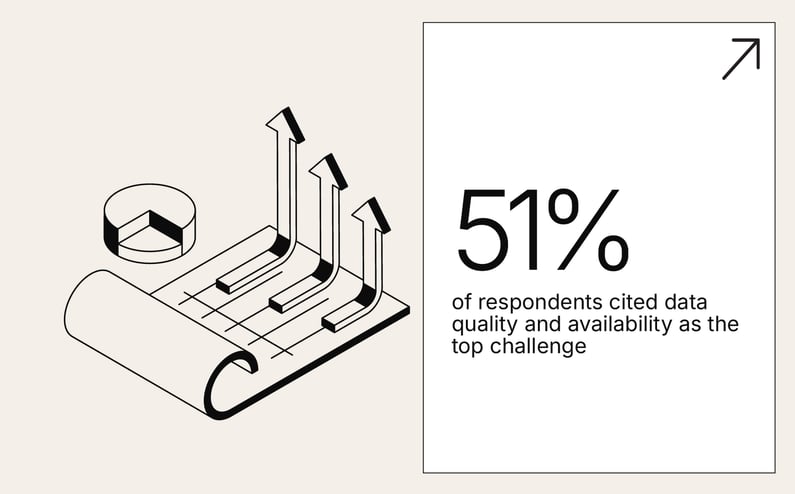
The barriers aren't primarily about skepticism toward AI. Only 2% of respondents say they have no confidence in it at all. The obstacles are operational and structural. Data quality and availability is the top challenge, cited by 51% of respondents. Scattered data sources, inconsistent formats, and legacy systems can make it difficult to deploy AI reliably at scale, and organizations that haven't invested in cleaner data pipelines often hit this wall as they try to move from pilot to production.
Security and privacy concerns rank second at 48%, reflecting the sensitivity of insurance data and the regulatory expectations that govern its use. Unclear ROI rounds out the top three at 40%. Not because insurers doubt AI's value in the abstract, but because translating that potential into specific, defensible business cases with measurable outcomes remains genuinely difficult, especially for initiatives that are newer or more complex.
Organizations that work through these barriers typically do so by starting in high-volume, repetitive workflows where savings are easiest to quantify and building confidence through live results rather than upfront certainty.
How Insurance Companies Are Formalizing AI Oversight in 2026
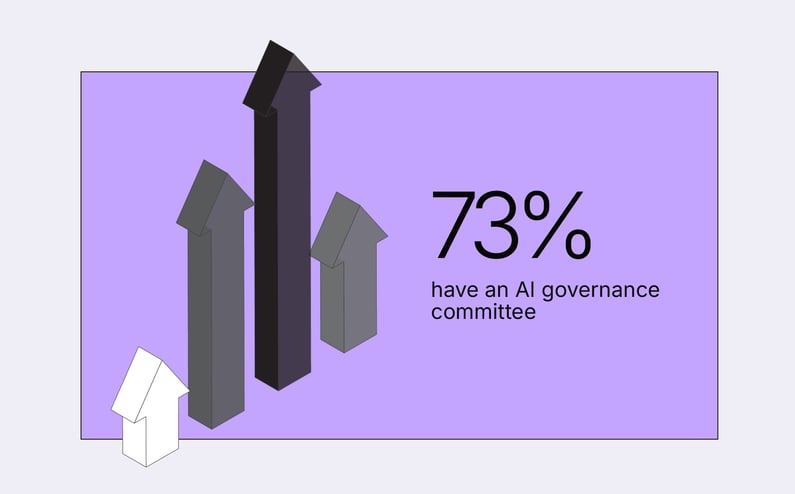
A year ago, most insurers were managing AI through informal oversight – a compliance team here, an IT lead there, no unified structure. That's changing fast. 73% now have an AI governance committee established or actively in progress, and 30% have a fully operational committee with a clear charter and defined responsibilities.
The reason this matters isn't bureaucratic. It's practical. In a regulated industry, structured oversight with clear decision rights, escalation paths, audit trails, and cross-functional accountability is what separates AI initiatives that scale from ones that stall.
Without it, even well-performing pilots struggle to move into production because no one owns the risk. The 25% of respondents with no governance plans aren't just organizationally behind. They are creating a liability that grows as their AI ambitions do.

The Insurance AI Gap Is Widening
The barrier landscape has shifted in just one year. In 2025, the top obstacles were limited skills and internal resources. This year, those concerns have been largely replaced by data quality, security, and ROI clarity. That's not a bad sign. It means the industry has moved past asking whether it can do AI and is now grappling with how to do it well at scale. The problems have gotten more sophisticated because the ambitions have too.
But that progress isn't evenly distributed. Insurers already running AI in production aren't just ahead on a timeline. They have built something that is genuinely difficult to replicate quickly: operational discipline, institutional knowledge about what works and what doesn't, refined workflows tested through real-world feedback, and governance structures stress-tested against live deployment. The organizations still in exploration aren't just behind on the calendar. They are solving problems their competitors have already worked through, and as production-stage leaders scale to their next use cases, that gap compounds.
The advantage isn't just where you are today. It's the organizational capability you are building as you go. 
AI adoption in insurance is no longer defined by experimentation. It's defined by execution, accountability, and measurable business impact. Insurers that succeed in 2026 will be those treating AI as a core operational capability, with clear ownership, defined success metrics, human oversight built into workflows from the start, and a commitment to continuous performance monitoring once solutions go live.
The organizations pulling ahead aren't doing anything mysterious. They picked a workflow, proved the value, built the governance around it, and moved to the next one. That discipline, repeated consistently, is what separates the leaders from the organizations that will spend another year in evaluation mode. The window for a leisurely exploration phase is closing. The real work is deployment.
