
AI in insurance is reshaping how white-collar work gets done – and it’s happening faster than many organizations expected. There have been numerous recent projections that maturing AI systems could eliminate entry-level white-collar work within the next five years. Meanwhile, insurance has been dealing with significant (and continual) talent shortfalls as hundreds of thousands of professionals approach retirement.
So, to our industry, the talent crisis isn’t a future problem – it’s a present reality. Insurers that respond by upskilling and redeploying their workforce with AI will scale faster, preserve expertise, and maintain service quality.
Because AI doesn’t replace the human element in insurance, it makes it more essential.
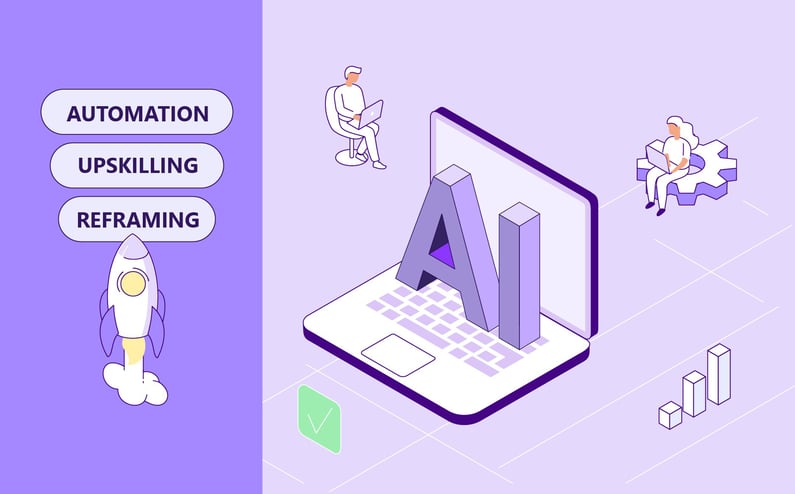
How AI Is Changing Insurance Roles Through Automation, Upskilling, and Reframing Work
Across insurance organizations, AI agents are already handling submission intake, loss-run extraction, certificate issuance, claims setup, and ACORD form processing, and other time-intensive, rules-based workflows. These shifts are redefining roles.
As automation takes over these repetitive, structured, and data-heavy tasks, insurers are freeing employees to focus on higher-value work that requires judgment, empathy, and human connection. AI is elevating these professionals’ impact across underwriting, claims, policy servicing, and operations.
Below are examples of how these roles are evolving in practice:
| Role | How AI is Changing this Role | Future Focus Through Upskilling and Redeployment |
| Underwriting Assistant (UA) / Assistant Underwriter | Tasks such as data extraction, submission triage, loss-run analysis, report ordering, and renewal or endorsement evaluation are increasingly automated by AI agents. | Roles will shift toward mastering underwriting fundamentals, exercising judgment on risk selection and prioritization, and building stronger relationships with brokers, producers, and underwriters. |
| Underwriter | AI pre-analyzes data, compiles comparative insights, and highlights anomalies. Underwriters spend less time gathering data and more time analyzing, pricing, and strategizing portfolios. | Deeper analytical reasoning, storytelling around risk, negotiation, and maintaining producer and client relationships. |
| Policy Services Representative / Specialist | AI processes endorsements, renewals, COIs, and document updates. Humans manage exceptions and client communications requiring discretion or context. | Enhanced customer service, proactive renewal outreach, human-in-the-loop AI exception handling, policy audit coordination, and multi-system integration oversight. |
| Claims Intake Specialist / Adjuster | AI organizes and triages FNOLs, validates data, and routes claims to the right teams. Adjusters focus on nuanced cases requiring empathy, negotiation, or legal judgment. | Emotional intelligence, problem-solving, and client reassurance, especially during high-stress claims experiences. |
| Data Entry / Loss-Run Processor | Manual extraction and entry replaced by AI-driven document understanding and validation. | Quality control, audit support, compliance review, and data accuracy analysis. |
| Operations / BPO Manager | AI automates tracking and reporting throughput and accuracy. Managers shift to coaching teams, refining processes, and overseeing AI performance metrics. | Leadership, change management, vendor governance, and cross-functional collaboration to sustain hybrid human-AI teams. |
Insurance remains an industry built on relationships. AI enhances speed, efficiency, and accuracy, enabling insurance professionals to process submissions, endorsements, and claims faster than ever before, with fewer errors and greater consistency. But even as automation sharpens operational performance, the human touch – personability, the ability to connect, explain, and reassure – continues to be the heart of great service. The real differentiator is not just how quickly your people issue policies or settle claims, but how genuinely customers feel understood and supported throughout the process.
Insurance will always depend on people who can build trust. AI helps them deliver that promise faster and more effectively but never replaces the human connection that defines our industry’s purpose.
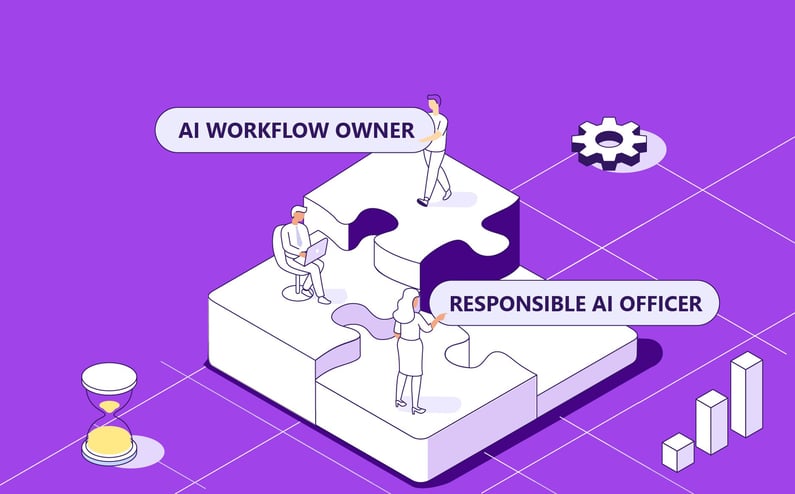
New Insurance Roles Are Emerging in AI-Enabled Operations
As traditional tasks evolve, insurers can create new hybrid positions that blend technical awareness with human expertise. These are recommendations, and naturally, each business’s specific needs, organizational structure, and AI maturity level will determine which roles make the most sense.
| New Role | Description | Why It Matters |
|
AI Workflow Owner/Digital Workforce Manager |
Oversees AI agents, monitors exceptions, and collaborates with vendors | Ensures performance, governance, and ethical AI usage |
| AI-Supported Customer Service Representative | Uses AI insights to anticipate client needs and personalize service | Combines technology efficiency with empathy and responsiveness |
| Insurance Data Translator/Risk Insights Partner | Bridges AI outputs and underwriting strategy | Turns analytics into business decisions and narratives |
| Change & Workforce Transformation Lead | Manages upskilling programs and cultural adaptation | Ensures employee engagement and career growth |
| Responsible AI Officer | Oversees fairness, compliance, and explainability | Builds regulator and customer confidence |
These emerging opportunities represent the fusion of intelligence and empathy, the new standard for the modern insurer.
Plan the Insurance Workforce Transition By Mapping Roles and Skills for AI
Transitioning an insurance organization into an AI-empowered workforce requires structured evaluation, cross-functional decision-making, and clear training pathways. The process should be data-driven yet empathetic, balancing operational needs with team members’ personal and professional growth.
Importantly, workforce mapping is not a one-time exercise. Roles may evolve further as AI accuracy improves, use cases expand, and adoption matures. Planning must be strategically thought out, recognizing that AI usage will evolve and grow over time, requiring periodic reassessment of responsibilities, capacity, and skill alignment. Insurers should plan for both short-term adjustments that accompany early implementation and long-term workforce redesign as automation becomes embedded in daily operations.
Here are 5 steps.
Step 1: Conduct task and skill inventories
- Identify which tasks in each role are repetitive, rules-based, or already partially automated.
- Quantify the time spent on each task and assess its automation potential.
- Capture each employee’s current skills, tenure, and performance in critical thinking, strategic thinking, communication, and adaptability.
- Document each employee’s career-path interests and long-term professional development goals, identifying where their aspirations align with emerging or redefined roles.
Step 2: Classify roles by evolution potential
- Automate and Redeploy: For tasks nearly 100 percent automatable, such as data extraction or entry. Redeploy these employees into oversight, validation, or relationship roles.
- Augment and Elevate: For partially automatable roles, such as underwriting assistants or claims adjusters. Focus training on analytical and interpersonal growth.
- Create and Expand: For emerging needs, such as AI Workflow Owners or Responsible AI Officers. Identify candidates with leadership or digital fluency potential.
Step 3: Build personalized learning and career paths
- Design tiered learning modules: foundational (AI basics), intermediate (domain-specific AI tools), and advanced (governance and analytics).
- Align training content with real workflows, for example, teaching underwriting assistants how to interpret or customize AI-generated loss-run summaries or review risk scores.
- Include mentoring or rotational opportunities across functions to build broader context and confidence.
Step 4: Involve the right decision-makers
A successful workforce redesign depends on collaboration across business units:
- Operations Leaders: Assess efficiency, throughput, and role alignment.
- Human Resources/Learning and Development: Design career pathways, manage morale, and track retention metrics.
- AI Governance Committee/IT: Validate which roles and workflows can safely transition to automation, ensuring compliance and transparency.
- Business Line Executives: Set priorities and define success metrics, such as cycle-time reduction, capacity gains, and engagement.
- Change Management/Communications: Ensure clear messaging that positions AI as an enabler, not a threat.
Step 5: Pilot, measure, and adjust
- Start small, one department and one process at a time.
- Measure baseline metrics, such as cycle time, quality, and satisfaction, then evaluate post-transition outcomes.
- Revisit workforce design periodically to account for short-term adjustments during implementation and long-term shifts as AI performance, data pipelines, and business strategies evolve.
- Maintain a strategic review of cadence that ensures the mapping process evolves alongside technology growth, keeping the organization aligned with both operational goals and employee development.
- Use pilot learnings to refine training plans and identify future champions for change.
The goal is a workforce roadmap that is practical, transparent, and flexible, giving employees clarity about where they are headed in the near term and how their careers can continue to grow as AI capabilities advance.
Shift Insurance Culture from Processing to Partnership
To succeed in an AI-enabled operating model, insurers must intentionally shift how work is defined, measured, and valued. The future of insurance is hybrid, with AI handling routine execution and people focusing on judgment-based or advisory roles. This requires a clear cultural pivot:
- Shift from tasks completed to value created
Redefine success beyond volume and speed by prioritizing decision quality, customer outcomes, and business impact. - Move from transactional service to trusted guidance
Enable team members to act as advisors, using AI-driven insights to support more informed, proactive, and personalized customer and producer interactions. - Reframe “job preservation” as career evolution
Highlight automation as a natural catalyst for upskilling and role expansion, giving employees a clear path to grow alongside AI rather than compete with it. - Balance efficiency with experience and trust
Use AI to improve speed and consistency but hold teams accountable for delivering experiences where customers feel understood, supported, and confident.
When leaders reinforce these shifts through metrics, messaging, and motivation, AI becomes more than a productivity tool. It becomes a foundation for stronger relationships, more resilient teams, and a culture built on partnership rather than processing.
AI is reshaping how insurance work gets done and redefining where human contributions matter most. As machines take on repetitive tasks, people gain the authority to focus on insight, relationships, and reassurance – the qualities that have always defined this industry.
Insurance AI agents demonstrate what’s possible when technology and human expertise are intentionally designed to work together, enabling faster throughputs, greater accuracy, and more engaged teams. Insurers that seize this moment to retrain, redeploy, and reimagine their workforce will emerge stronger, more resilient, and better positioned for the future.
This shift requires intention. Insurers must actively redesign roles, invest in upskilling, and lead cultural change to ensure AI strengthens both their workforce and customer experience.
Technology may process policies, but insurance will always depend on people – those who provide clarity in moments of uncertainty, build trust over time, and deliver peace of mind. That foundation will not change.