
Artificial intelligence (AI) is fast becoming indispensable to insurance operations. As insurers evaluate AI solutions, one question comes up frequently:
“Is this predictive AI?”
To answer that question clearly, it helps to step back and define what we mean by AI in the first place.
AI is an umbrella term that includes different types of models built for different purposes. For this discussion, we’ll focus on two categories: predictive AI models and generative AI models.
Generative AI models are powered by large language models (LLMs). An LLM is a type of AI trained on vast amounts of text so it can understand language, interpret documents, and generate responses in plain English. Tools like ChatGPT are examples of systems built on LLMs.
There is often confusion at this point. Technically, LLMs “predict” the next word in a sentence when generating text. But that technical definition is different from what insurers likely mean when they ask whether a solution is predictive.
In insurance, a predictive AI model is designed to forecast outcomes, such as estimating the likelihood of loss or producing a risk score. A generative AI model serves a different purpose.
Both types of AI are valuable. But they are built to solve different problems, operate in different ways, and create value in different parts of the insurance workflow.
Understanding that distinction is important for insurers who want to apply AI effectively, measure results appropriately, and design processes that are both efficient and governable.
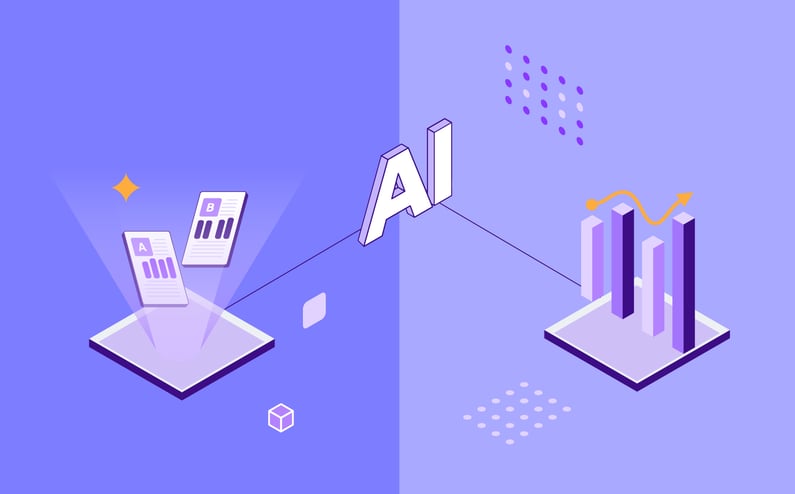
The Key Difference Is Where Generative and Predictive AI Create Value
The simplest way to distinguish predictive AI models from generative AI models is to look at the type of problem each is designed to solve.
Predictive AI models are built to forecast outcomes. They analyze structured data – such as policy attributes, claims history, geography, or prior loss experience – to estimate probabilities, classify risk, or support pricing decisions. Their purpose is to answer questions about the future, such as:
-
How will this risk align with our appetite or risk-tolerance?
-
Which claims are most likely to result in litigation?
-
How should this policy be priced relative to others?
The output of a predictive model is typically a score, probability, or category. These models are designed to be measured, validated, and monitored over time.
Generative AI models are built to understand and work with information. Insurance operations rely heavily on unstructured inputs – emails, submissions, loss runs, statements of value (SOVs), inspection reports, adjuster notes. Generative AI models can read and interpret this material, extract key details, summarize complex documents, and organize information into usable formats.
Their purpose is to reduce manual review, improve consistency, and make information easier for insurance professionals to act on.
In practical terms, predictive AI evaluates risk. Generative AI finds and clarifies the underlying information needed to evaluate risk.
That functional difference determines where each belongs inside an insurance workflow.

Where Each Model Excels in Insurance Workflows
The difference between predictive and generative AI becomes clearer when viewed through the lens of day-to-day insurance work.
Predictive AI Models Excel at Forecasting RiskPredictive models are designed to estimate probabilities and classify outcomes. They rely on structured data – defined variables such as prior losses, location, construction type, driver history, or claims patterns – to forecast future outcomes. The outputs of predictive models are typically scores, probabilities, or classifications. These models can be measured and tested against historical results, which makes them well suited for pricing, underwriting selection, reserving, and other analytically driven decisions. When the goal is forecasting, predictive AI is the appropriate tool. |
Generative AI Excels at Processing and Organizing InformationGenerative models address a different operational challenge. Insurance workflows are heavily document-driven. Submissions, correspondence, inspection reports, and loss documentation often contain critical information embedded in unstructured formats. Generative AI can read and interpret these materials, extract key data points, summarize content, identify missing information, and organize outputs into consistent formats. Their role is to reduce manual review, improve intake consistency, and make information usable across teams. |
Where Each Model Has Limits
Both predictive AI and generative AI are powerful tools, but no technology is without tradeoffs. In insurance, where decisions carry real consequences, it's worth knowing where each model can fall short.
Key limitations of predictive AI include:
-
Models trained on historical data can perpetuate past underwriting or pricing patterns, which creates both fairness concerns and regulatory exposure.
-
Predictive models require substantial clean, structured data to perform reliably, a real barrier for new lines or smaller books. The variables feeding the model determine the quality of the output.\
-
A predictive model is only as current as the data it was built on, as loss patterns, behaviors, or market conditions evolve; model accuracy erodes without active monitoring and recalibration.
Key limitations of generative AI include:
-
Hallucination risk – models can confidently extract or summarize information incorrectly, which in a claims or policy context can carry significant consequences.
-
Performance variability with low-quality or ambiguous input documents.
These limitations don't disqualify generative AI from insurance workflows. They define where human oversight matters most. Confidence thresholds, review queues, and clear escalation paths turn known failure modes into manageable checkpoints rather than hidden risks.
Why Being Predictive Isn’t the Point
It is important to recognize that not every AI solution in insurance needs to forecast risk in order to deliver measurable value.
In many insurance workflows, the primary bottleneck is the time and inconsistency involved in reviewing documents, extracting information, and preparing files for evaluation. Underwriters and claims professionals often spend significant time sorting through and organizing data before a decision can even be made.
Generative AI directly addresses this constraint. By improving how information is processed and structured upstream, insurers can increase speed, consistency, and throughput while creating cleaner inputs for downstream analytics, including predictive models.
How Predictive and Generative AI Models Work Together
The distinction between predictive and generative AI becomes most useful when viewed within a complete workflow.
Consider a commercial property submission. A generative AI model can:
-
Review broker emails and attachments
-
Extract exposure details
-
Identify missing or inconsistent information
-
Structure the data into a consistent format
At that point, the document is clearer, more complete, and easier to evaluate. A predictive model can then analyze structured inputs to produce a risk score, a loss estimate, or a pricing indication.
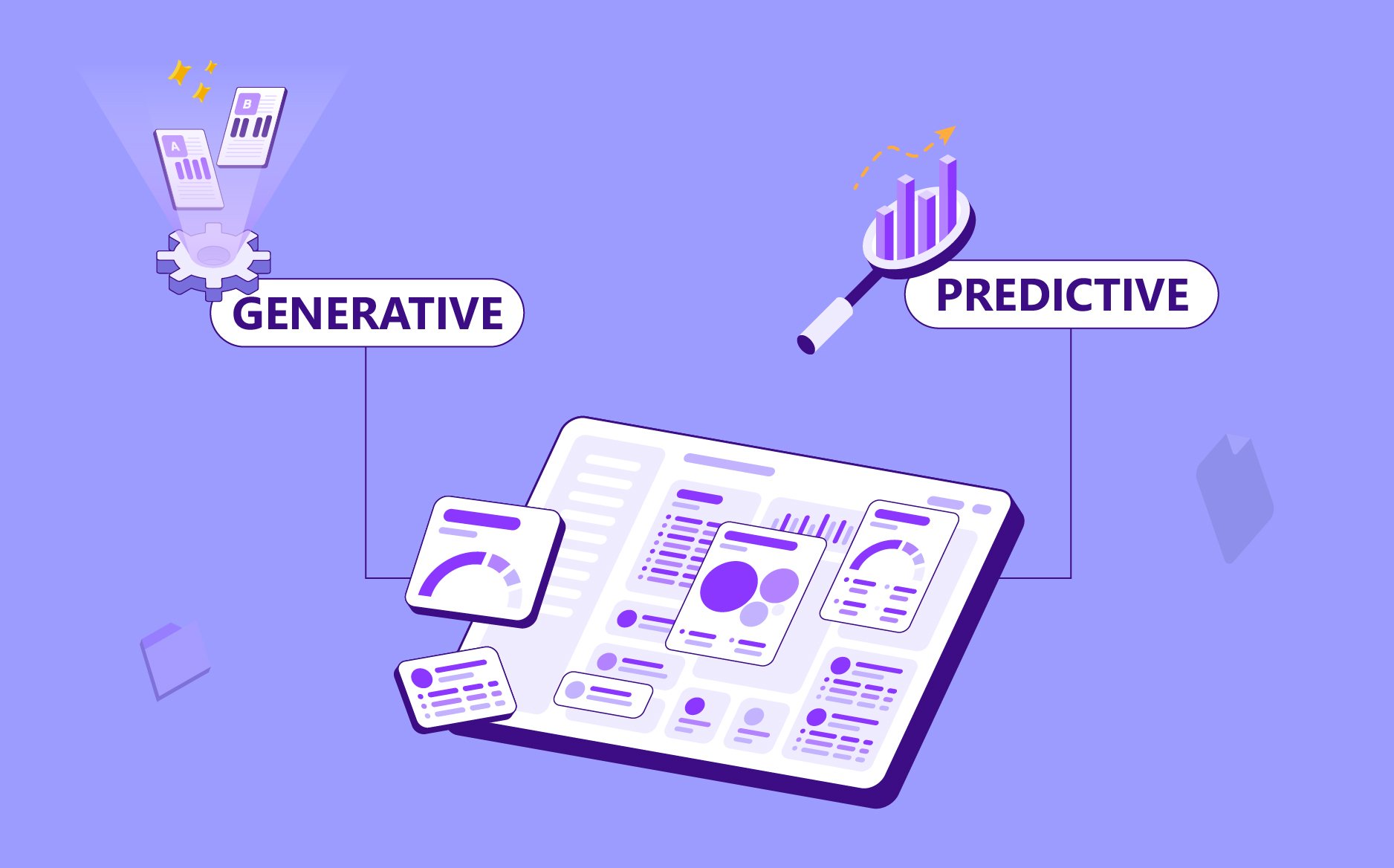
So, generative AI prepares the information, so predictive AI can evaluate the risk. One reduces operational friction, and the other supports analytical decision-making.
When these roles are clearly defined, workflows become faster and more consistent. Inputs are cleaner. Outputs are easier to measure. Oversight and governance become more straightforward because each component has a defined function.
This is where insurers see meaningful impact, not by asking one model to do everything, but by aligning each type of AI to the task it is best suited to perform.
Think about AI in terms of how work actually gets done. Different AI models are built for different jobs. The value comes from using each one where it fits and building them into everyday processes in ways that can be measured and managed.
For many insurers, progress starts with improving how information moves through the business – how submissions are reviewed, how files are organized, and how much time professionals spend preparing work before they can make a decision. Improving these steps creates more consistent inputs and smoother execution across teams.
When information moves more efficiently, decisions happen faster, oversight becomes clearer, and results are easier to track.
The priority is applying AI to the parts of the workflow that create the most friction. That clarity is what turns AI from a tool into a dependable part of how the business operates.